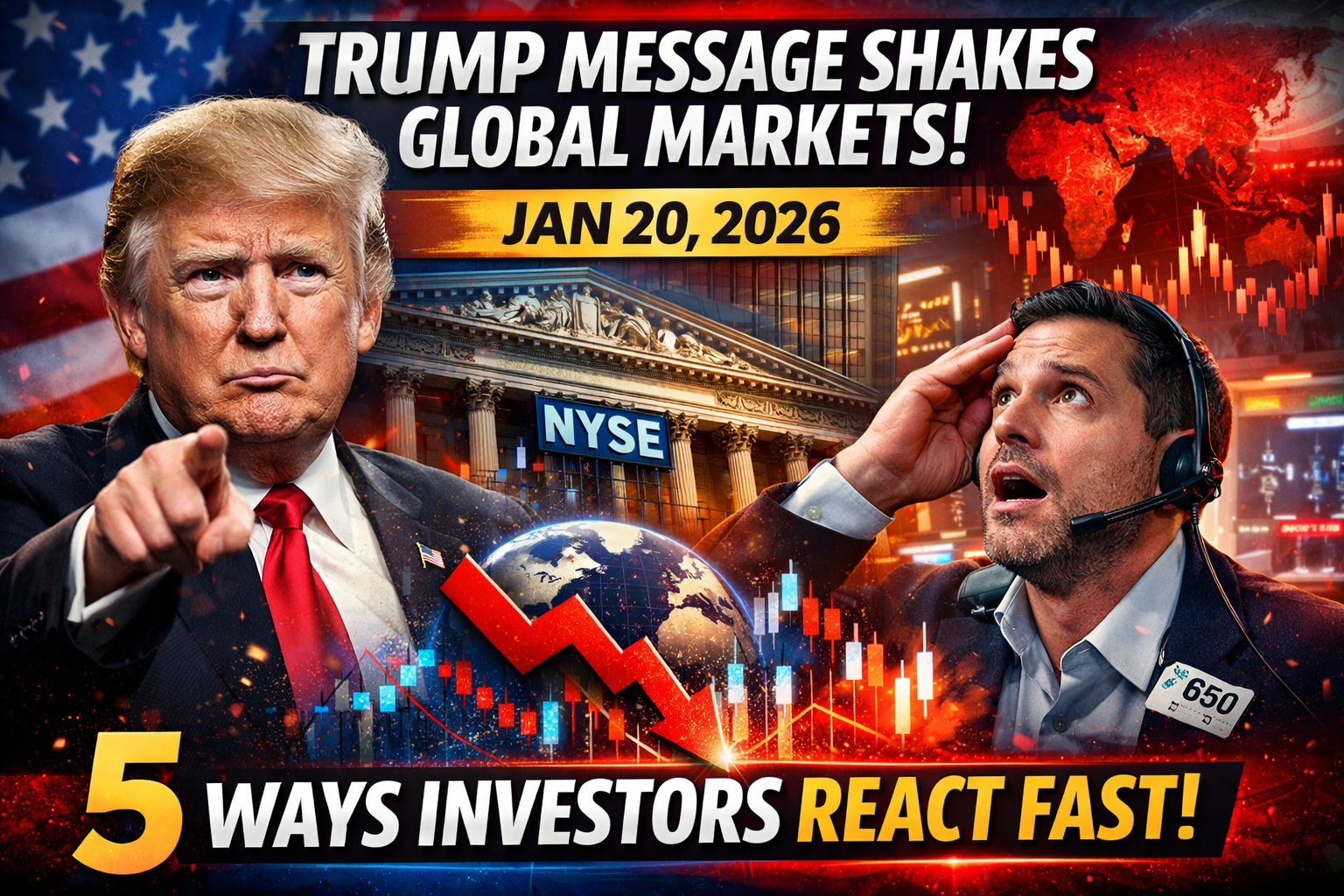
In a dramatic turn of events this week, financial markets around the world experienced increased turbulence after a series of policy signals from U.S. President Donald Trump triggered sharp reactions among traders and investors. What began as another geopolitical headline quickly rippled through global financial systems, sparking both Wall Street volatility and widespread debate about the longer-term effects of the Trump market impact.
On January 19, 2026, President Trump announced a controversial tariff threat on several European nations, tied to his intention to acquire Greenland. The move sent shockwaves through markets in the U.S., Europe, and beyond. Stock futures in the U.S. fell sharply following the announcement, indicating that investors were adjusting their portfolios fast amid uncertainty about trade policy and its global effects.
Understanding the Trump Economic Message
The crux of the market move was a direct result of the latest Trump economic message — a strong push to leverage trade policy as a negotiating tool against allied nations. Trump threatened to impose a 10% tariff on goods from eight European countries beginning February 1, 2026, escalating to 25% if negotiations stalled.
These tariff threats weren’t ordinary policy shifts — they were positioned as leverage tied to a geopolitical aim that few investors had been forecasting. That surprise element contributed significantly to the global stock market reaction as traders reevaluated risks associated with transatlantic trade relations and tariff warfare that could have broader economic implications.
Immediate Wall Street Volatility
Although U.S. markets were closed for the Martin Luther King Jr. holiday when the announcement broke, stock futures dropped sharply, signalling early nervousness among American investors.
When markets reopen, the focus will be on key indices such as:

- Dow Jones Industrial Average
- S&P 500
- Nasdaq Composite
Each of these measures offers a snapshot of overall financial health and investor willingness to take on risk. A decline in futures often reflects risk-off behaviour, where traders move capital to safer assets like Treasury bonds, gold, or cash.
Investor Sentiment: Fear, Rebalancing and Opportunity
Investor sentiment — the collective mood of market participants — shifted from cautious optimism to risk aversion almost immediately after the tariff threat. Many analysts pointed out that it wasn’t necessarily the size of the tariff itself that rattled markets, but the political uncertainty behind it. Markets generally prefer predictability, and when a geopolitical aim merges with economic policy, it often leads to unease and sudden portfolio rebalancing.
European markets also reacted negatively: the STOXX 600, DAX, and CAC 40 indices all registered declines as traders digested the news.
The sell-off in European stocks further reinforced the global stock market reaction, and its knock-on effects were felt across Asia and other emerging markets as well.
Despite this short-term volatility, some market strategists emphasize that volatile phases often create opportunities. When markets quickly adjust pricing to new information, it provides chances for disciplined investors to buy quality assets at more attractive valuations — particularly in sectors poised to benefit from structural trends like technology and defence.

The Geopolitical Angle and Trade Uncertainty
A major dimension of the recent market fluctuation stems from the geopolitical nature of the Trump economic message. By tying tariff threats to strategic objectives — such as U.S. interest in Greenland — traders began pricing in a scenario that goes beyond routine trade negotiations.
Global institutions, like the International Monetary Fund (IMF), have cautioned that escalating trade tensions could destabilize economic growth and amplify volatility across world markets, a warning that underscores how political decisions can quickly translate into economic anxiety.
For U.S. investors, this geopolitical uncertainty translates into:
- Short-term market swings
- Higher risk premiums
- Increased demand for safe-haven assets
All of these elements contribute to Wall Street volatility and wider macroeconomic implications.
What This Means for U.S. Investors
American investors have a range of responses to Trump market impact signals:

1. Defensive Positioning
Faced with uncertainty, many institutional investors shifted capital toward less volatile asset classes such as:
- U.S. Treasury bonds
- Precious metals (e.g., gold, silver)
- Cash equivalents
These are traditional safe havens that generally perform well during periods of market stress.
2. Sector Rotation
Some sectors may outperform even in turbulent times. For example:
- Defence stocks gained in late trading as geopolitical uncertainly increased.
- Energy and commodities may see mixed performance depending on supply chain shifts.
3. Technical and Long Term Perspective
Long-term investors often look past short-term swings and focus on fundamentals:
- Corporate earnings
- Economic growth rates
- Innovation trends
For many, short-term volatility can be a buying opportunity rather than a sell signal.

Policy Outlook and the Federal Reserve
While Trump economic message and tariff policy grabs headlines, the Federal Reserve’s role in steering monetary policy also affects markets. Traders closely watch Fed commentary on interest rates, inflation, and economic growth. Any divergence between fiscal policy (e.g. tariffs) and monetary policy (e.g. interest rate direction) can intensify fluctuations in asset prices.
Market confidence often hinges on the perception of central bank independence. When political rhetoric appears to undermine that independence, as seen in past criticism of Federal Reserve leadership, markets may react with added caution.
Is This Just a Short-Term Sell-Off?
History shows that markets often overreact to unexpected political events, then stabilize once policies unfold and investors have time to interpret their long-term implications. The recent sell-off resembles similar past episodes where tariffs led to an initial sharp decline followed by a rebound as clarity emerged — but each geopolitical scenario is unique.
What remains clear is that investors must stay informed, disciplined and strategic. Weekly economic data releases, corporate earnings reports, and global developments — including trade negotiations — will all play roles in shaping market direction.
Final Takeaway
The recent Trump market impact highlights how political decisions can rapidly influence markets worldwide. The global stock market reaction, fueled by tariff threats and geopolitical strategy, underscores the interconnected nature of modern finance.

For U.S. investors, the key priorities are:
- Understanding immediate Wall Street volatility
- Monitoring shifts in investor sentiment
- Identifying strategic investment opportunities
While short-term market swings can be unnerving, history shows that markets adapt and recover as fundamentals reassert themselves.
By staying focused on long-term goals, American investors can navigate volatility with resilience and confidence.
FAQ’s
How did Trump’s message impact the stock market?
Trump’s economic message increased uncertainty, causing sharp market movements and higher Wall Street volatility as investors reacted to potential trade and tariff risks.
Why did global markets react so quickly to Trump’s statement?
The statement raised concerns about tariffs and geopolitical tensions, triggering a rapid global stock market reaction as investors adjusted risk exposure.
What does Wall Street volatility mean for U.S. investors?
It signals short-term uncertainty, but it can also create buying opportunities for long-term investors focused on strong fundamentals.
How is investor sentiment in the USA affected by Trump’s economic message?
Investor sentiment USA shifted toward caution, with many investors moving to safer assets while closely watching policy developments.
Is the Trump market impact likely to be short-term or long-term?
Most analysts expect short-term volatility, but long-term market direction will depend on actual policy decisions and economic data.